

Faster and more sustainable AM production, innovative applications ranging from medicine and toolmaking to the oil and gas industry, as well as new approaches to AM education: the Formnext Awards 2025 once again honor young, innovative companies, sustainable business ideas, and groundbreaking technologies across six different categories. The finalists have now been selected by the respective juries and will present their exhibits both online ahead of the trade fair and as part of a special exhibition at Formnext. The winners will be announced during a ceremonial awards presentation on November 20, 2025. Public voting is already open again this year, allowing audiences to participate in selecting the winners.
The finalists across the six award categories point the way to the future of additive manufacturing. Their innovations not only address current challenges such as increased sustainability and production efficiency, but also offer highly practical applications and specialized manufacturing solutions – for example in robotics or dental technology. The finalists stand out for their exceptional degree of innovation, technological maturity, and professional business concepts. Visitors to Formnext can experience all finalists at the Formnext Awards Special Exhibition (Hall 11.0, Booth D82). The announcement of the winners and the award ceremony will take place on Thursday, November 20, starting at 4:20 p.m. on the Industry Stage (Hall 11.0, D72). In addition, the finalists can be discovered immediately on the Formnext website. Public voting is open in all categories until Thursday, November 20, 2025 at 12:00 p.m., with the audience vote counting as an additional jury vote.
AMbassador Award: From the AM Ecosystem to Recognized Education
The AMbassador Award honors outstanding individuals or organizations that have had a unique impact on the industry and its users through innovative training and education approaches or active advocacy for additive manufacturing. Finalist Naiara Zubizarreta, Director of ADDIMAT – the Spanish Additive Manufacturing Association celebrating its 10th anniversary this year – has led the strategy and growth of the Spanish AM ecosystem since 2015, building a strong community that now comprises more than 100 members.
Also reaching the final with her educational efforts is Irena Heuzeroth, engineer and Senior Trainer in Injection Molding | Additive Manufacturing. Together, the Würzburg-Schweinfurt Chamber of Industry and Commerce (IHK) and the Plastics Center (SKZ) offer the practical training program “Certified Industrial Technician, Specialization in Additive Manufacturing.” The continuing education course covers the entire 3D printing process chain – from materials and processing to design and manufacturing methods, as well as topics such as energy systems, hydraulics, and occupational safety.
Another finalist hoping to open new pathways in AM education is Gustavo Melo from RWTH Aachen University, who has developed a technology-based, data-driven training methodology.
Design Award: From LNG Measurement to Prosthetics for Children in Kenya
In the Design Award category, the following finalists impressed with outstanding AM designs and products:
The Limb Kind Foundation, together with Hewlett-Packard and global partners, launched a 3D printing project in Kenya, producing customized prosthetic sockets for children abroad and transporting them to Kenya, where orthopedic technicians fit and adapt them free of charge.
IKM Flux, EOS, Valland, and ToffeeX collaborated to develop a flux evaporator that measures the energy content of LNG gas far more precisely than conventional devices. Using thermo-fluidic topology optimization among other AM techniques, the evaporator helps eliminate small but potentially very costly measurement inaccuracies in LNG deliveries.
The University of Design Schwäbisch Gmünd developed the hand-therapy gadgets “Grabbit,” designed to help train hand mobility for illnesses, injuries, or age-related weakness. The products combine TPU lattice structures and PA12 with ash wood.
(R)Evolution Award: Sand and Injection Molding Tools and New AM Production for Dental Technology
The (R)Evolution Award recognizes groundbreaking products, technologies, or services that deliver exceptional value to users. This year’s finalists showcase innovations from industrial manufacturing and the dental sector.
Portugal-based Erofio fully 3D-printed a metal mold for a 100-ton injection molding machine as part of its Inov.iQ project, in collaboration with machine manufacturer Engel. Designed for ultra-thin parts with wall thicknesses of just 1 mm, the lightweight mold reduced tool weight by 75% and energy consumption by 30%, while productivity increased thanks to shorter cycle times.
Laempe Mössner Sinto GmbH developed a 3D printing system for the mass production of sand cores and successfully implemented it at BMW Group. With output exceeding 1,100 cores per day, the system ranks among the world’s fastest binder-jetting printers.
With CORiTEC Mythos, imes-icore presents the world’s first fully automated hybrid manufacturing system that combines additive coating (PEM) with precise milling/grinding in a single five-axis process. This technology enables multicolor, multi-material dental restorations with outstanding surface quality, precision, and aesthetics – from crowns and bridges to implant structures.
Rookie Award: Innovations for Medical, Dental, and FDM Printing
The Rookie Award honors young individuals with promising business ideas whose companies were founded less than one year ago or are yet to be founded. This year’s finalists present solutions for the medical and dental fields, as well as technical improvements for 3D printers:
Fidentis operates a digital manufacturing system that uses multi-material PBF-LB/M, robotics, and automation to mass-produce high-quality cobalt-chrome and gold dental prosthetics composed of multiple materials.
To improve treatments such as for respiratory distress, 3DMyMask employs facial 3D scanning and additive manufacturing to create custom silicone masks. The project unites neonatologists, industrial engineers, and entrepreneurs within the IAM3DHUB ecosystem.
Tesseract developed easy-to-use linear motors optimized for FDM printers. These self-correcting motors move directly along a magnetic rail without mechanical transmission, enabling faster and more precise motion.
Start-up Award Supported by Fluxo Technologies: Faster AM Production, Robotics, and Medical Advancements
With volumetric additive manufacturing (VAM), Perfi Technologies aims to surpass conventional 3D printing by forming every point of an object simultaneously rather than layer by layer. This can potentially reduce production times from hours to seconds, eliminate support structures, and minimize post-processing.
The Hungarian start-up Allonic has introduced a new AM technology called 3D Tissue Braiding – a textile-based additive manufacturing method designed to make complex robotics simple enough for mass production.
Meanwhile, Swiss company Nureo AG offers software tools that promise to fully automate the 3D design of components.
Thailand-based OsseoLabs focuses on healthcare, improving orthopedic and maxillofacial surgery through AI-supported surgical planning and patient-specific 3D-printed implants. According to the company, its porous OsseoMatrix™ scaffolds and OsseoVision™ platform improve precision while reducing operating times by 50% and planning times by 90%; more than 200 clinical cases have already been completed.
Also addressing medical applications, Vienna-based Biomotion Technologies FlexCo has developed a platform that automates and standardizes bioprinting of 3D tissue models, aiming to make drug screening more reliable.
Sustainability Award Supported by Renishaw: Filter Eliminates Metal AM Residues
Finalists for the Sustainability Award, which evaluates AM applications and products based on their full product life cycle, are Smart Materials 3D Printing, Continuum Powders, and EOS.
Smart Materials 3D develops innovative biodegradable 3D printing materials from locally sourced agri-industrial residues, setting benchmarks for a sustainable circular economy in additive manufacturing.
Continuum Powders transforms high-quality metal scrap into application-ready metal powders using its Greyhound Melt-to-Powder (M2P) platform and OptiVantage quality framework.
EOS presents a metal laser-sintering filtration system that separates reusable powder carried away in exhaust air while neutralizing reactive byproducts such as condensate, soot, and ultrafine particles generated during the AM process. These substances are classified as hazardous waste and incur high disposal costs, while reclaiming reusable powder saves costs and reduces CO₂ emissions. EOS’s new recirculating air filter system, to be presented at Formnext 2025, converts highly reactive condensates into stable metal oxides that can be disposed of safely. According to EOS, this filtration and integrated oxidation technology are both environmentally and economically sustainable.
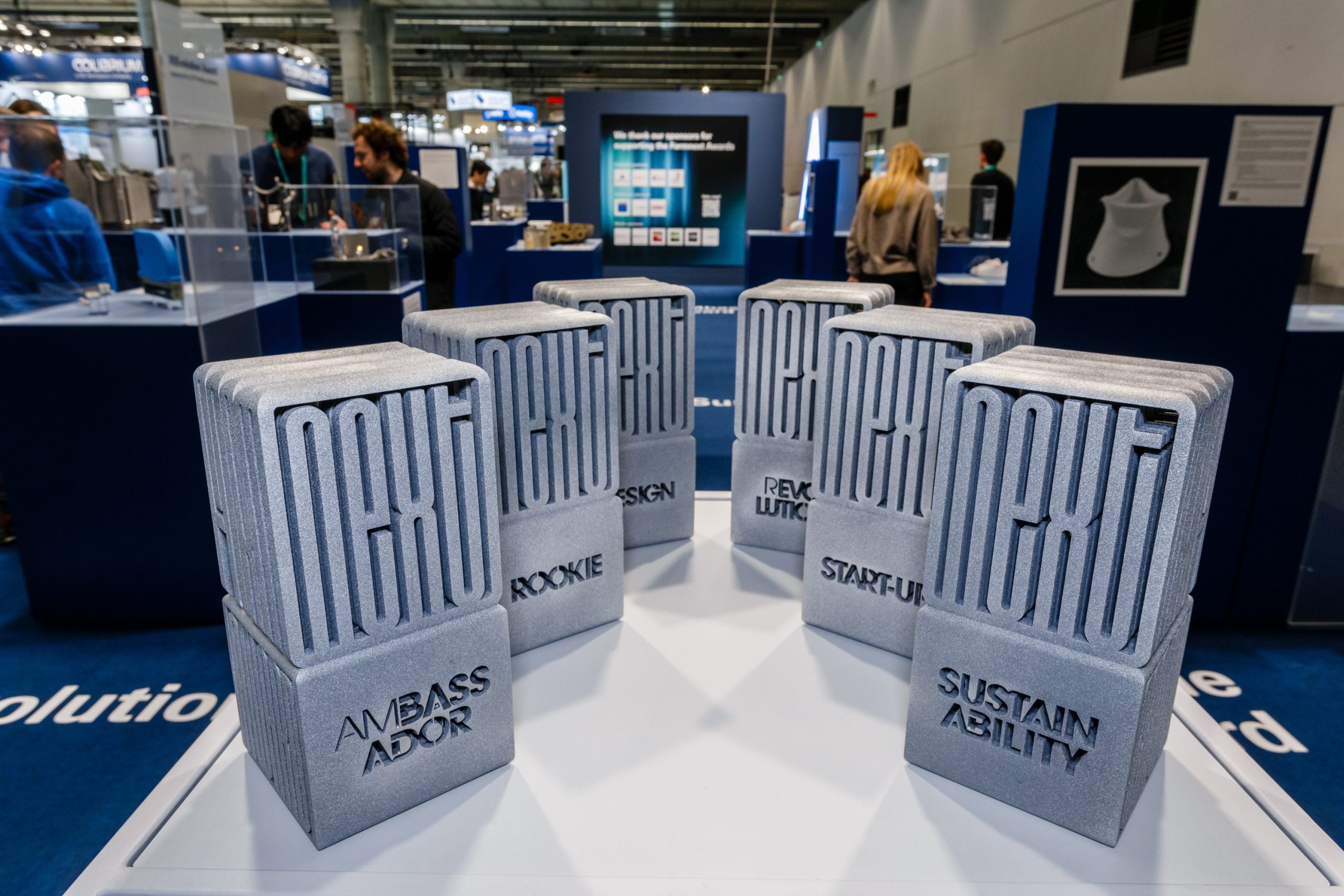
Winners in each category will receive unique award trophies – provided by sponsors Sutosuto (design) and FKM Sintertechnik (production) – in addition to attractive prizes and monetary awards during the ceremonial presentation.
Further information, online voting, and introductions to all finalists can be found at formnext.com/awards.