

High-voltage storage system housings in battery-electric vehicles must meet a wide range of requirements. From a safety perspective, high impact resistance and the ability to absorb energy in a crash or provide protection against short circuits are essential. At the same time, the material must be heat-resistant and flame-retardant. Efficient heat dissipation is equally crucial. Nevertheless, the sensitive cells must be protected from excessive cooling at sub-zero temperatures. Stones or road salt must not damage the housing. In addition, it must fit precisely into the vehicle underbody structure, contribute to body stiffness, and—thanks to low intrinsic weight—increase vehicle range. Aluminum foam offers the properties required to meet all of these demands simultaneously.
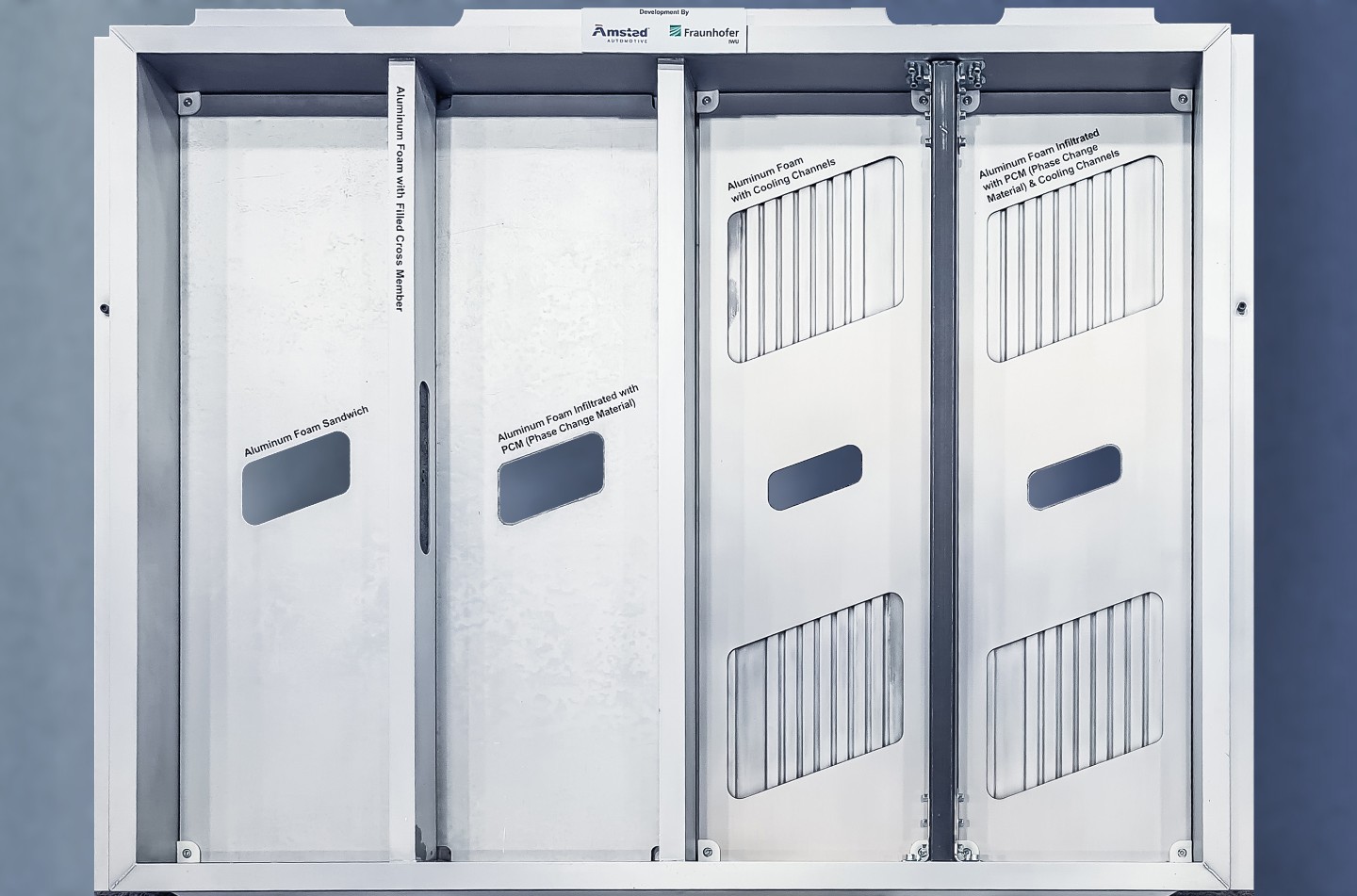
At the Battery Show North America in early October in Detroit, Fraunhofer IWU and the automotive supplier Amsted Automotive presented an integrally designed battery housing made of aluminum-foam sandwich structures. These consist of two solid aluminum face sheets enclosing an inner core of aluminum foam. If required, the sandwiches can incorporate cooling structures or phase-change materials (PCM).
Fraunhofer IWU has succeeded in integrating PCM into closed-cell aluminum foam. PCMs can absorb or release very large amounts of thermal energy while changing their physical state (solid/liquid) without significantly changing their own temperature. This makes them particularly suitable for efficient thermal management in lithium-ion batteries.
The demonstrator presented in Detroit illustrates the wide range of potential series solutions. Depending on prioritized performance characteristics, the following variants can be realized: pure AAS (more precisely: aluminum–aluminum-foam sandwiches), AAS with infiltrated PCM, AAS with cooling structures, or AAS with both cooling structures and PCM.
To ensure that battery housings made of aluminum foam find widespread use in mass-production vehicles in the future, the research team led by Dr. Thomas Hipke and Dr. Rico Schmerler is now focusing more closely on economic viability. One key factor for future manufacturing costs is the raw material. As Hipke explains: “We increasingly rely on recycled material for producing aluminum foam. This is not only significantly more cost-effective but also reduces the carbon footprint substantially.”