

At drinktec 2025, the Fraunhofer Institute for Process Engineering and Packaging IVV presented three technology solutions that, through the use of AI, powerful software, and newly developed contamination sensor technology, put an end to the safety-driven, systematic oversizing of cleaning processes in hygiene-critical areas such as heat exchangers, tanks, or pipelines.
The pivotal factor for this is knowing when, where, and how much contamination is present and, based on this, carrying out a precisely adapted cleaning process.
In this way, costly safety buffers in cleaning can be reduced without compromising product safety, valuable resources can be saved significantly, and downtime minimized.
All three solutions can be integrated into existing plants and systems with minimal effort.
“CoControl-FouliQ”
Predictive detection of fouling in heat exchangers – increasing safety and efficiency
High protein = high cleaning effort?
The AI-based monitoring system “CoControl-FouliQ” enables the predictive detection of fouling already during its development process. It is therefore particularly suitable for the manufacturing process of currently highly demanded high-protein products such as yogurt drinks or mixed milk beverages.
These pose a particular challenge for dairy companies, because their high protein content significantly increases the risk of deposits – this makes process management more difficult, increases the risk of microbial contamination, and thus leads to more frequent cleaning with associated higher resource use and longer downtime.
“CoControl-FouliQ” consists of clamp-on temperature sensors, a compact computing unit integrated into a hygienically designed control cabinet, and a specially trained machine-learning model for data evaluation and fouling prediction.
The system uses the real-time data from sensors at the inlet and outlet of the heat exchanger and evaluates these using the machine-learning model. Temperature profiles serve as indicators of emerging deposits and thus make it possible to plan cleaning no longer at fixed intervals but on a needs-based and efficient basis.
Through demand-based planning of cleaning processes, the system not only contributes to resource conservation and optimization of plant availability but also increases product safety by ensuring a safe and consistent process operation.
“AJCsens”
50% less cleaning time – 100% safety and control in tank cleaning
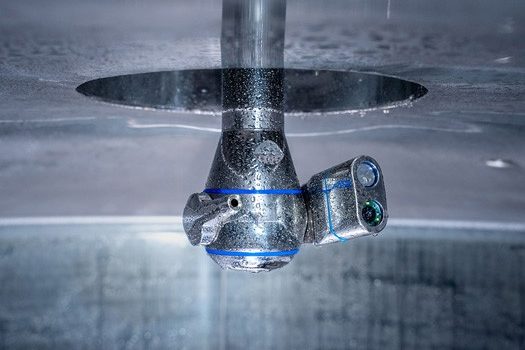
With “AJCsens,” Fraunhofer IVV presents a smart spray-cleaning system for demand-based tank cleaning which, with its enormous savings potential, provides a forward-looking answer to constantly increasing time and resource pressure.
The highly compact onboard contamination sensor technology of the targeted jet cleaner enables permanent inline monitoring of the cleanliness status and thus, for the first time, direct detection of the contamination condition on the inner tank surfaces. In combination with the capability to specifically adapt cleaning and motion paths to the tank geometry and to the contamination patterns typically to be expected, needs-based cleaning control becomes possible, resulting in a reduction of cleaning time of more than 50%.
For this purpose, the cleaning system combines a motor-driven targeted jet cleaner freely controllable in two axes with a highly compact and robust contamination sensor in a hygienic design housing as well as intelligent software.
The optical hybrid contamination sensor primarily detects contaminants using the fluorescence method (UV light) or white light on the plant surfaces.
The potential of the technology solution has already been demonstrated in a case study at a well-known dairy company and is being presented at drinktec, among other things, in a lecture.
“CoControl-QCM”
Reliable inline cleaning monitoring for pipelines
To date, cleaning monitoring of closed pipeline systems has been carried out primarily in the product or cleaning medium, but not where the actual contamination is located: directly on the pipe wall. To directly determine when the cleaning process has truly been successfully completed, “CoControl-QCM” was developed.
The quartz crystal–based sensor solution enables reliable inline detection of a wide variety of contaminants such as product deposits, biofilms, and crystalline fouling. With the sensor, product changes or different cleaning agents and phase changes can also be detected, as viscosity-related changes affect the damping behavior of the fluid above the sensor. The highly compact sensor operates according to the inverse piezoelectric effect and detects even extremely thin layers of dirt that cannot be detected visually.
With the help of a special evaluation algorithm, it is now for the first time possible to directly measure the contamination status during fouling and cleaning processes based on changes in the natural frequency of the quartz crystal and to draw reliable conclusions regarding cleaning success and actual cleaning requirements. The highly complex sensor can be integrated into existing systems with minimal effort.