

Industrial coatings are more than just decorative surfaces. They protect materials from corrosion, weathering, and mechanical stress while defining the visual appearance of a product. Without modern coating systems, today’s high industrial quality standards would be difficult to achieve.
Coating technology, however, operates in a field of tension: on the one hand, legislation and social expectations are driving the reduction of volatile organic compounds (VOC), which promotes the increasing use of water-based systems. On the other hand, daily industrial practice shows that established solvent-based systems remain indispensable due to their robustness, process reliability, and proven performance. As a specialist with nearly 100 years of experience, Stoz provides the following overview of current conditions and trends in industrial coating, surface engineering, and corrosion protection.
Fundamental Principles of Coating Systems
In general, coating systems are divided into one-component (1K) and two-component (2K) systems.
1K coatings: All components are contained in a ready-to-use mixture. Curing occurs physically through solvent evaporation or chemically through reaction with atmospheric oxygen or moisture. Application is straightforward, but resistance and durability are lower compared with more complex systems.
2K coatings: The two components – resin and hardener – are mixed shortly before application. The ensuing chemical reaction forms a densely crosslinked film with high hardness, abrasion resistance, and chemical resistance. Processing requires greater discipline, but these systems are the first choice when maximum performance is required.
Stoving enamels: These coatings fully cure only through heat exposure in an oven. Crosslinking of polyester or acrylic resins with amino resins (usually melamine) produces a highly crosslinked, thermoset film. This results in surfaces with exceptional hardness, chemical resistance, gloss retention, and high process and end performance. From an ecological standpoint, the energy demand of oven curing must be taken into account.
Solvent-based stoving enamels have been the standard in automotive OEM coating and coil coating for decades. Their water-based counterpart, cathodic dip coating (KTL), is now applied to virtually every automotive body-in-white.
Water-Based Systems
The development of water-based coating systems has progressed significantly. 1K coatings based on acrylic or polyurethane dispersions are widely used today. They dry quickly, are elastic, and non-yellowing, making them suitable for furniture manufacturing and interior applications. However, they also have weaknesses: blocking and scratch resistance are limited, they are sensitive to climatic conditions, and drying times increase significantly at high humidity or low temperatures.
Water-based 2K coatings, typically based on polyurethane or epoxy resins, mitigate many of these weaknesses. With high hardness, good chemical resistance, and stable abrasion resistance, they are increasingly used for demanding industrial flooring, corrosion protection, and high-quality furniture surfaces. Their processing, however, is more challenging due to precise mixing ratios, short pot lives, and increased sensitivity to environmental fluctuations.
The ecological advantage of water-based systems must be assessed carefully. Although VOC emissions are lower, water evaporation often requires longer or more energy-intensive drying processes. In addition, binders dispersed in water need stabilizing auxiliaries that are not always ecologically neutral. The overall environmental balance therefore depends strongly on process design and, above all, on the service life of the coating.
A special case is water-based stoving enamels, most notably KTL coating. This is the automotive industry standard because it ensures uniform, full-surface corrosion protection. Its strengths are comprehensive coverage of complex geometries; its weaknesses are the high energy input for curing and limited decorative functionality.
Solvent-Based Systems
Solvent-based coating systems continue to set the benchmark for technical stability and process reliability. 1K systems such as classic alkyd and acrylic coatings offer excellent flow properties, strong adhesion, and reliable processability even under less ideal climatic conditions. Acrylic resins are known for high UV stability and clarity, while alkyd resins provide elasticity and robustness, although they have a tendency to yellow.
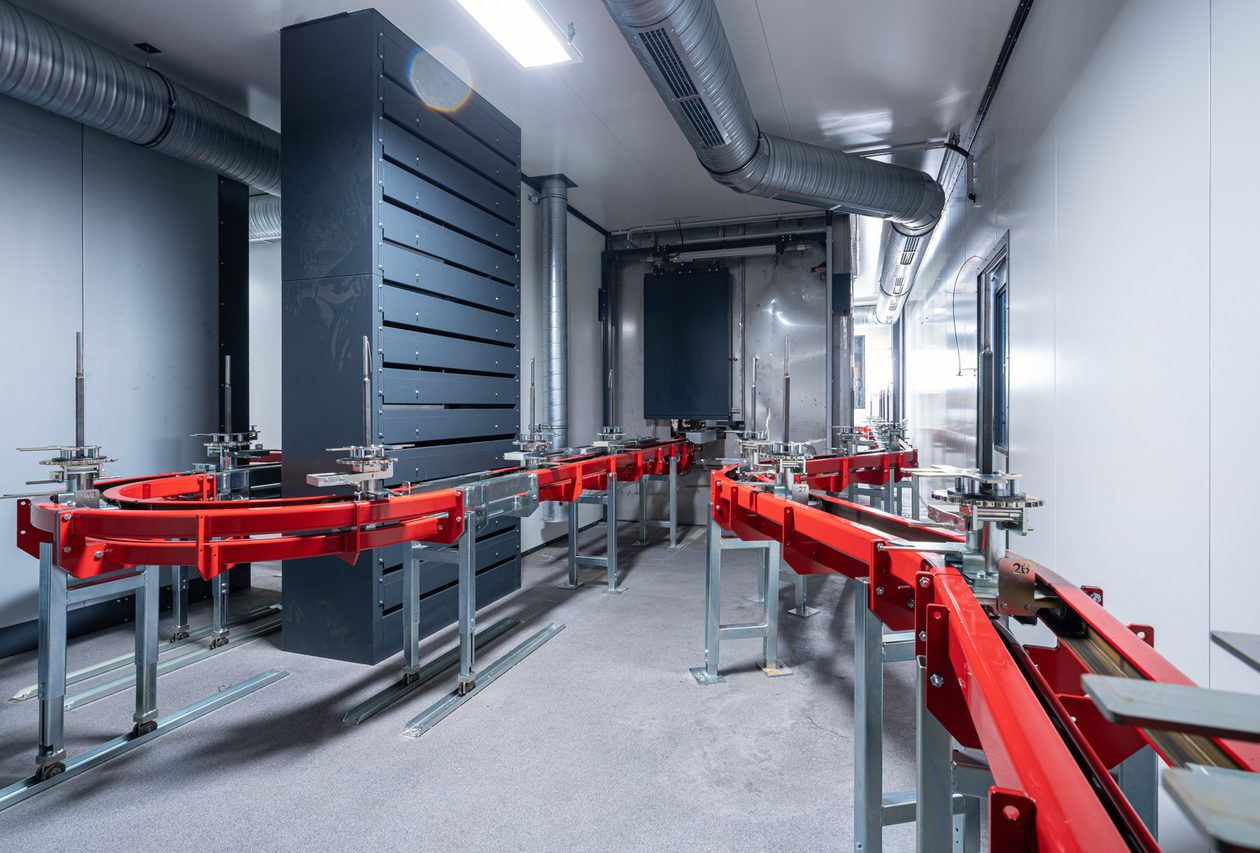
Solvent-based stoving enamels, usually polyester or acrylic resins combined with melamine resins, are particularly well established. They cure at temperatures of approximately 140–180 °C, yielding highly crosslinked, thermoset films of exceptional hardness, chemical resistance, and gloss retention. They remain indispensable, especially in automotive OEM painting and coil coating, and are difficult to replace owing to their proven process reliability over decades.
The strengths of solvent-based systems become even more apparent in 2K coatings. Polyurethane coatings are universal high-performance finishes combining hardness, elasticity, and chemical resistance. Acrylic PUR systems unite brilliance and light fastness with polyurethane crosslinking strength and are indispensable in automotive manufacturing, aerospace, and high-end mechanical engineering. Epoxy coatings remain the gold standard for heavy corrosion protection, tank linings, and pipeline coatings due to their unmatched adhesion and resistance to aggressive media.
From an ecological perspective, modern solvents are increasingly produced from renewable raw materials. When combined with the longer service life of coatings and reduced need for recoating, the environmental balance of solvent-based systems can be altogether positive.
Trends and Developments
The goal is to reconcile sustainability with the demands of industrial practice. For this purpose, the coatings industry has developed high-solids systems with higher solid contents and reduced solvent levels, lowering VOC emissions without sacrificing the advantages of solvent-based chemistry. Hybrid systems are also gaining importance by combining different binder types to achieve tailored properties. At the same time, bio-based resins and sustainable raw materials are receiving growing attention.
Currently, these new systems do not yet match the established technologies in terms of processing stability or final durability. While water-based systems continue to gain market share, they still encounter limitations in industrial practice. Development toward greater sustainability continues, and through its expertise in research and development, Stoz evaluates innovations early and provides customized solutions for industrial coatings that are both economically viable and high performing.
Conclusion
Industrial coating systems reflect the balance between innovation, regulation, and technical reality. Water-based systems make an important contribution to emission reduction, but their ecological advantages are not always as clear-cut upon closer examination, and performance remains limited in certain applications.
Solvent-based systems, particularly in their two-component variants, have proven their strengths over decades and remain the performance benchmark. Their extensive track record, long service lives, and the increasing use of bio-based solvents ensure that they will continue to play an indispensable role in industrial coating technology in the future.