


A recent study shows that solar installations reduce the electricity bills of consumers, commerce, and industry by several billion euros each year – with an upward trend. Subsidizing new solar power installations pays off for society as a whole. Funding cuts, such as those announced by Federal Minister for Economic Affairs Katherina Reiche, should therefore be avoided at all costs, concludes the German Solar Industry Association (BSW-Solar). They would lead to a collapse in PV expansion, as demonstrated by a recent representative survey of property owners.
The energy-sector consulting firm Enervis, commissioned by BSW-Solar, analyzed the impact of photovoltaic installations on the exchange electricity price. Energy experts concluded that, without solar energy, the exchange price of electricity last year would have been on average 15 percent higher. In total, solar-related savings for consumers, commerce, and industry in 2024 amounted to around 6.1 billion euros. In addition, export revenues of 1.3 billion euros are being generated from electricity exports. A typical private household already saves around 50 euros per year solely due to the existing share of solar energy in the electricity mix.
“With this, not only the approximately three million households with their own solar rooftops benefit from inexpensive solar power, but all citizens. The solar price-dampening effect on the electricity exchange is now also benefiting the economy,” says Carsten Körnig, Chief Executive Officer of BSW-Solar. For example, industrial consumers with electricity consumption of ten gigawatt-hours saved around 120,000 euros last year, the authors of the study calculated. The share of solar energy in the German electricity mix amounted to around 15 percent in 2024 and is expected to approximately double over the next ten years.
In the coming years as well, solar installations will continue to reduce electricity prices for the economy and the general public. According to the Enervis study, the wholesale electricity price will already be lowered by 21 percent in 2030 solely as a result of the additional photovoltaic expansion planned by 2030. For private households, this results in annual savings of more than 70 euros, and industrial enterprises with consumption of ten gigawatt-hours will be relieved by around 180,000 euros per year. Added to this is the avoidance of future climate-related costs amounting to billions of euros over the coming years and decades.
To realize the price-reducing effect of solar installations on electricity prices, photovoltaic expansion must continue in the coming years along the target pathway enshrined in law in 2023. However, this is by no means a given, warns Körnig: “Attractive and reliable framework conditions form the necessary breeding ground to be able to continue reaping the fruits of the energy transition, in the form of effective climate protection and a solar price dampener.”
A survey conducted by BSW-Solar among 132 installation companies at the end of last year found that, in their assessment, only around 4 out of 10 customers in the residential PV segment would purchase a rooftop PV system even without EEG subsidies. This assessment was recently confirmed by property owners in a representative YouGov survey commissioned by BSW: of the 248 property owners surveyed who are already planning to purchase a rooftop PV system, only around 4 out of 10 would (rather) continue to opt for the purchase even if EEG subsidies were abolished or significantly reduced. According to the survey, only around 12 percent would be absolutely certain to install a rooftop PV system under these conditions.
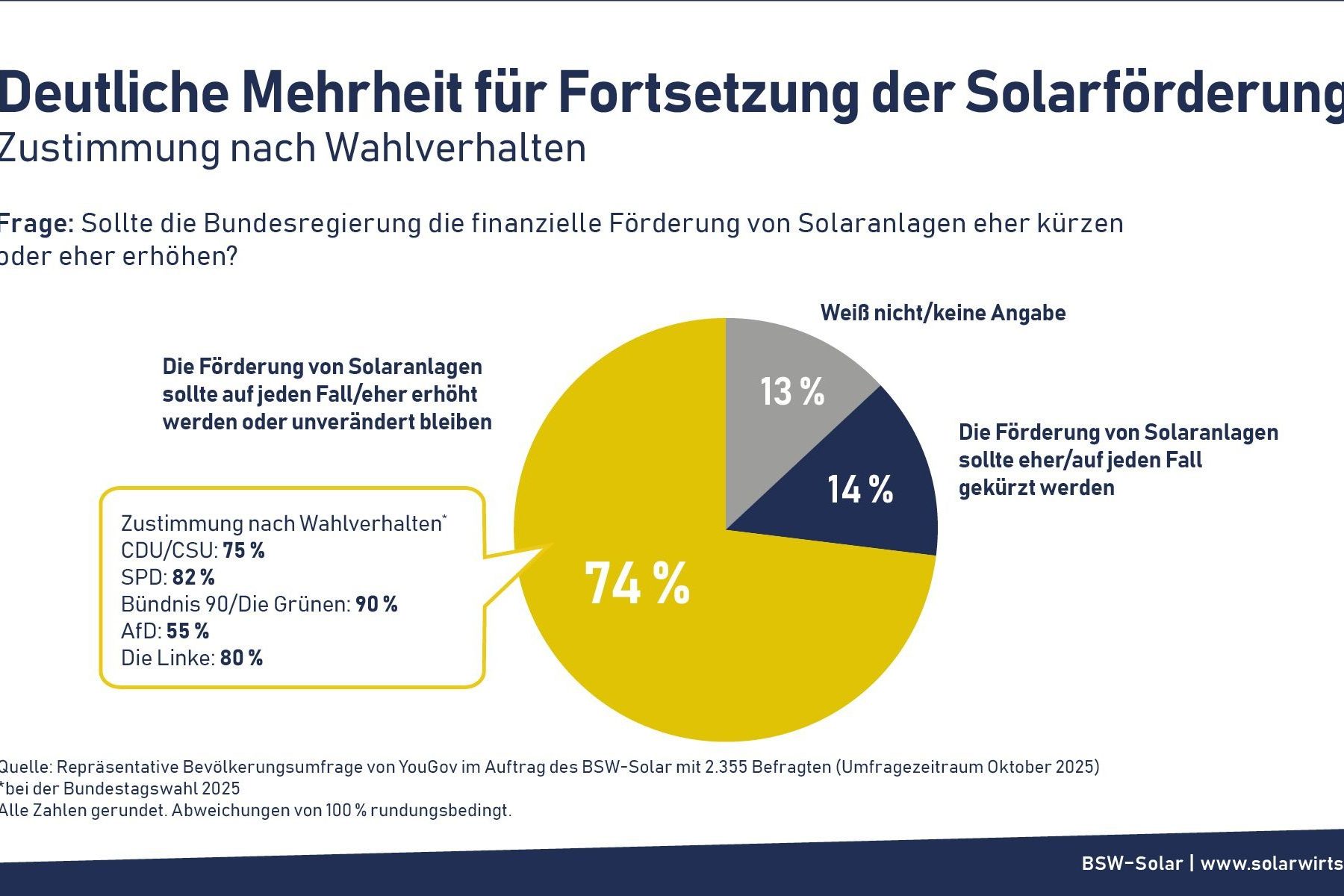
This would ignore the will of voters: in a representative population survey conducted by YouGov on behalf of BSW-Solar, around 8 out of 10 of the 2,355 respondents argued against slowing down solar expansion. More than 80 percent of Union and SPD voters want the federal government to (rather) accelerate the expansion of solar energy or continue it at the current level. In the survey, 75 percent of CDU/CSU voters also indicated that financial support for solar installations should be increased or remain unchanged.
The Federal Association therefore appeals to the Federal Minister for Economic Affairs to abandon the plan to abolish EEG subsidies for building photovoltaics.