

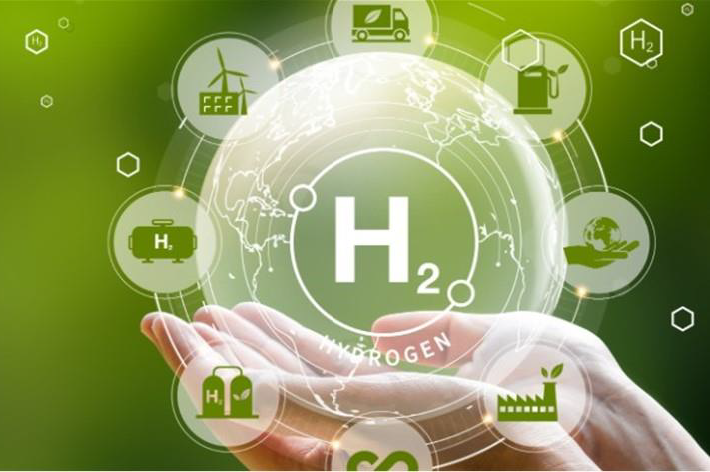
A new study by the Fraunhofer ISI shows how the city of Lingen (Ems) can strategically position itself as a green hydrogen region – with concrete recommendations for action for the coming years. The analysis by the Leipzig researchers is based on comprehensive data evaluation and interviews with regional stakeholders from business, science, politics, and public administration. The key findings: the region should establish support structures for hydrogen projects, utilize electrolyzer waste heat for energy supply, and further advance research into hydrogen-based propulsion technologies and synthetic fuels.
With the construction of electrolyzers by the RWE Emsland gas power plant and the energy company bp, the city of Lingen (Ems) has laid the foundation for the industrial production of green hydrogen in the Emsland region in recent years. Connection to the power and hydrogen core network already enables large quantities of “green” electricity and hydrogen to be generated, stored, and distributed in Lingen (Ems). In addition, the city promotes and coordinates hydrogen activities in the region, among other initiatives through the H2-Region Emsland network jointly established by Lingen (Ems) and the Emsland district. Until now, however, a regional future strategy for green hydrogen to systematically plan and promote measures had been lacking. The study by Fraunhofer ISI’s Leipzig researchers now provides local stakeholders with concrete recommendations for the coming years.
Smart energy generation and supply
During the production of green hydrogen via electrolysis, waste heat is generated that could be used for regional heat supply to households and commercial areas in Lingen (Ems), explains Ann-Kathrin Dieterle, researcher in the Regional Transformation and Innovation Policy Department at Fraunhofer ISI in Leipzig and lead author of the study. In the long term, reconversion into electricity via hydrogen-capable gas turbines can also make an important contribution to security of supply. At the Emsland site, RWE’s gas power plant is already planning to deploy such systems together with Kawasaki – particularly for so-called “dark doldrums,” weather conditions with low solar and wind power generation. Digital solutions, such as those being developed at the IT-Campus Lingen & KI Park e. V. initiated by the city of Lingen (Ems), should complement these developments in a meaningful way, Dieterle explains. This would position the location as a pioneer of smart energy systems.
Hydrogen-based propulsion technologies and synthetic fuels
Companies such as Krone, Bücker & Essing, and bp are already researching or producing alternative propulsion systems and synthetic fuels for heavy vehicles in the region – ranging from ships and trucks to agricultural machinery. Dieterle’s team recommends expanding this thematic focus as a long-term regional strength, for example through joint research projects with Osnabrück University of Applied Sciences. “The region brings together numerous competencies along the hydrogen value chain,” Dieterle says. “Now it is about strategically linking these competencies and creating suitable framework conditions for hydrogen innovation projects.”
Support structures for positioning in the hydrogen market
The research team describes these framework conditions with four structural measures intended to help the city of Lingen (Ems) further position itself in the hydrogen market over the coming years. With the H2Factory Lingen, the researchers propose a regional test center where companies can test their hydrogen technologies under real conditions – from production and storage through to application.
In addition, the researchers recommend explicitly aligning existing regional business networks with the future hydrogen market. Exchange forums or topic-specific entrepreneur breakfast meetings offer opportunities to promote regional synergies and initiate new partnerships. Startup support in the hydrogen sector should also be strengthened: Dieterle recommends conducting a feasibility study to examine the demand for and design of a regional accelerator program and to further develop existing startup ecosystems, co-working spaces, and incubators in a targeted way. Finally, the authors outline how a hydrogen campus at Osnabrück University of Applied Sciences – Campus Lingen – with practice-oriented degree programs, an endowed professorship, laboratories, and doctoral programs could contribute to the regional innovation system and support research and development activities.
“The study results now provide us with a sound foundation to further develop our activities strategically along the entire value chain – with the goal of expanding Lingen as a leading location for the hydrogen economy: innovative, sustainable, and a European pioneer of the hydrogen sector,” explains Lingen’s Mayor Dieter Krone. The proposed strategic steps aim to secure the long-term competitiveness of the city of Lingen (Ems) and the Emsland region in the hydrogen market, retain skilled workers, and create new jobs. At the same time, they pursue the goal of specifically improving conditions for local companies, stimulating new investments, and positioning the region as an attractive location for new players in the hydrogen economy. The recommendations are based on the study “H2 Innovate: Strategies for the local anchoring of hydrogen applications,” commissioned by the business development agency of the city of Lingen (Ems) and now publicly available.