


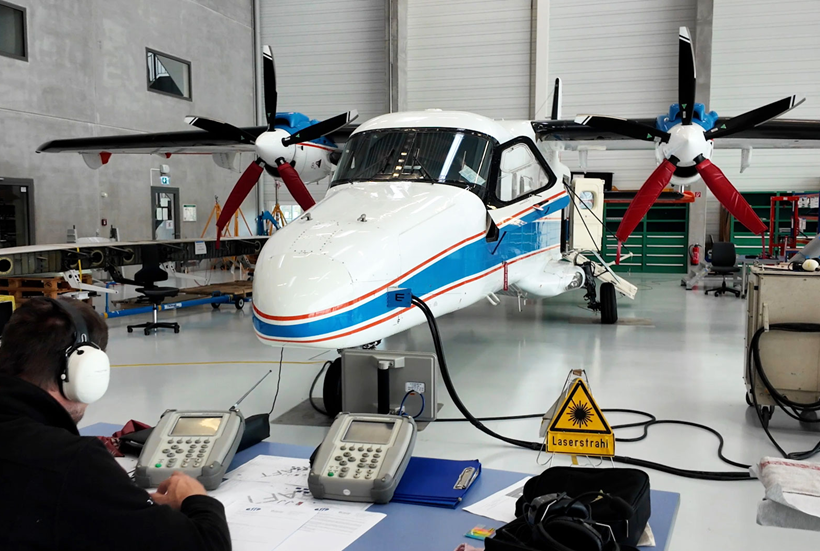
With a flight experiment between Oberpfaffenhofen and Erlangen, the latest key demonstration of the QuNET initiative has successfully been completed today. The aircraft served as a mobile node within a quantum network and established a connection to a ground station, where the photons were successfully received and measured. The technologies demonstrated in this key experiment are pioneering for future secure quantum communication.
It is not easy to transmit individual photons in a targeted manner from an aircraft, capture them at a ground station, and reliably detect them. Researchers have now succeeded in doing just that: they repeatedly measured various quantum channels between the aircraft and a ground station, transmitted photons to an ion trap, and tested technologies for quantum key distribution. The flight experiment was conducted as part of the QuNET initiative, which develops technologies for quantum-secure communication. Photons – particles of light – can be used to generate quantum cryptographic keys that make future communication virtually immune to eavesdropping. These technologies are also groundbreaking for a future quantum internet connecting quantum computers.
The experiment involved researchers from the German Aerospace Center (DLR), the Max Planck Institute for the Science of Light (MPL), Friedrich-Alexander University Erlangen-Nürnberg (FAU), as well as the Fraunhofer Institutes for Applied Optics and Precision Engineering (IOF) and the Heinrich Hertz Institute (HHI). The results have now been presented to the Federal Ministry for Research, Technology and Space (BMFTR), which funds the QuNET initiative. Quantum key distribution is particularly important for the communications of governments and authorities, but also more generally for protecting everyday infrastructure and data in the future.
“We are working on practical solutions for satellite-based quantum communication, enabling the transmission of quantum states over great distances and the generation of secure keys. In optical fibers, this is only possible over a few hundred kilometers. Quantum encryption via satellites, however, enables virtually unlimited distances on Earth,” explains Florian Moll from the DLR Institute of Communications and Navigation. To overcome long distances, satellites, aircraft, or other mobile platforms are expected to become part of future quantum networks.
In the current experiment, a DLR research aircraft operated by the Flight Experiments facility was used. The scientists installed an optical communication terminal aboard a Dornier 228. The aircraft functioned as a mobile node in a quantum network and established a link to an optical receiving station on the ground. This ground station is a mobile container with an integrated receiving terminal, known as the QuBUS, provided by the Fraunhofer IOF in Jena.
Fraunhofer IOF Responsible for Tracking and Fiber Coupling
Research into advanced systems for highly secure quantum communication has been a focus at Fraunhofer IOF for many years. In the latest flight campaign of the QuNET initiative, the researchers from Jena contributed their expertise at multiple levels. On board the DLR research aircraft, a module developed in Jena with an integrated photon-pair source was flown to generate entangled light particles. These particles were transmitted from the aircraft to the QuBUS. There, a specialized tracking system ensured that the receiving terminal of the ground station followed the aircraft’s movement and maintained the link. During transmission through the atmosphere, turbulence and disturbances inevitably occur. Correcting these effects to ensure a stable connection is the task of adaptive optics systems specially developed in Jena.
For the current experiment, several research flights over Erlangen were conducted in recent months, since the ion trap used to measure the received photons is located in the laboratories of the local MPL. From the QuBUS, the free-space received signals were coupled into optical fibers and routed to the experimental setups in the QuBUS and the MPL laboratories. This fiber coupling of the signals was also the responsibility of the Fraunhofer researchers. “The tracking and fiber coupling provided by Fraunhofer IOF thus created the necessary environment for the actual experiments,” explains Christopher Spiess from the Fraunhofer Institute in Jena.
Technically Highly Complex
Handling individual photons is challenging: for quantum communication they must be generated at high quality and clearly detected even under strong external disturbances. In addition, the wavelength of the photons must be precisely adjusted to achieve the best possible results. “In our various trials, we have shown that this is indeed possible. The approach we tested is not only viable from aircraft, but also from satellites,” adds Florian Moll.
The states of the “flying” particles were successfully verified in measurements at the MPL ion trap, achieving a central objective of the experiment. This communication technology could also be used, for example, to connect quantum memory systems or quantum computers within a future quantum network.