

Research investigation project with the Bavarian Laser Center focuses on practical safety standards
What sounds like a passionate dance is, in reality, serious safety research:
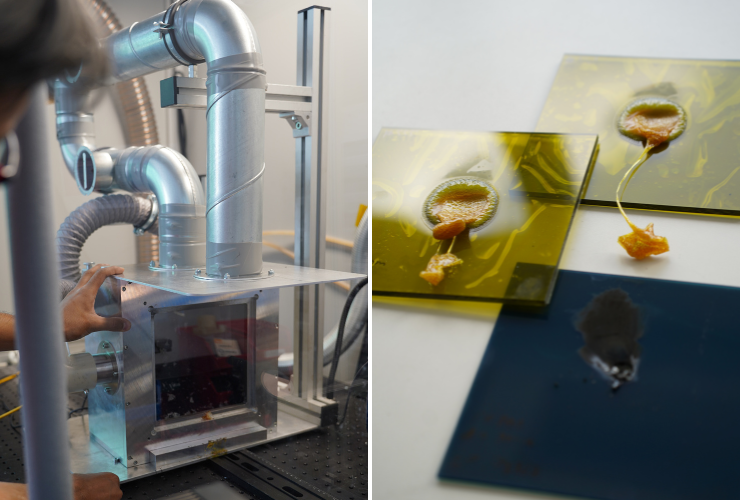
SALSA – short for StrahldurchmesserAbhängigkeit der Standzeiten von LaserSchutzAbschirmungen (beam-diameter dependency of service life of laser safety shielding) – is a joint research project by laservision and the Bavarian Laser Center (BLZ) that was launched in May 2022.
What is the SALSA project about?
Reliable protective measures are essential when using high-power lasers on material-processing machines. However, existing standards such as EN 60825-4 and EN 12254 often reach their limits – either because testing procedures are too complex or because they are not sufficiently close to real operating conditions. Particularly critical is the standardized beam diameter of 1.0 mm specified in the norms, which rarely reflects real-world applications.
SALSA provides a solution
The aim is to determine mathematically describable relationships between beam diameter, irradiance, and a defined protection time. These correlations will enable laser manufacturers and users to determine the appropriate shielding for a given application solely on the basis of existing standard tests – without the need for additional, time-consuming, case-specific testing.
“With SALSA, we want to make the application of laser safety easier, safer, and more practical – in other words, make everyday work simpler,” says the project team.
Support from experts and funding
An advisory board of experts accompanies and supports the project, which is funded by the Bavarian Research Foundation (BFS). The research results are published in Laser Magazin (issue 2/2025).
About LASERVISION GmbH & Co. KG
LASERVISION is one of the leading manufacturers offering the complete range of laser safety products. The company develops, manufactures, and distributes laser safety goggles, curtains, small filters, and cabin windows made from various plastics and mineral glass types. All products are CE certified and comply at least with the applicable EN 207/208 standards. Most standard products also meet the even more stringent requirements of the DIN GS standard.