

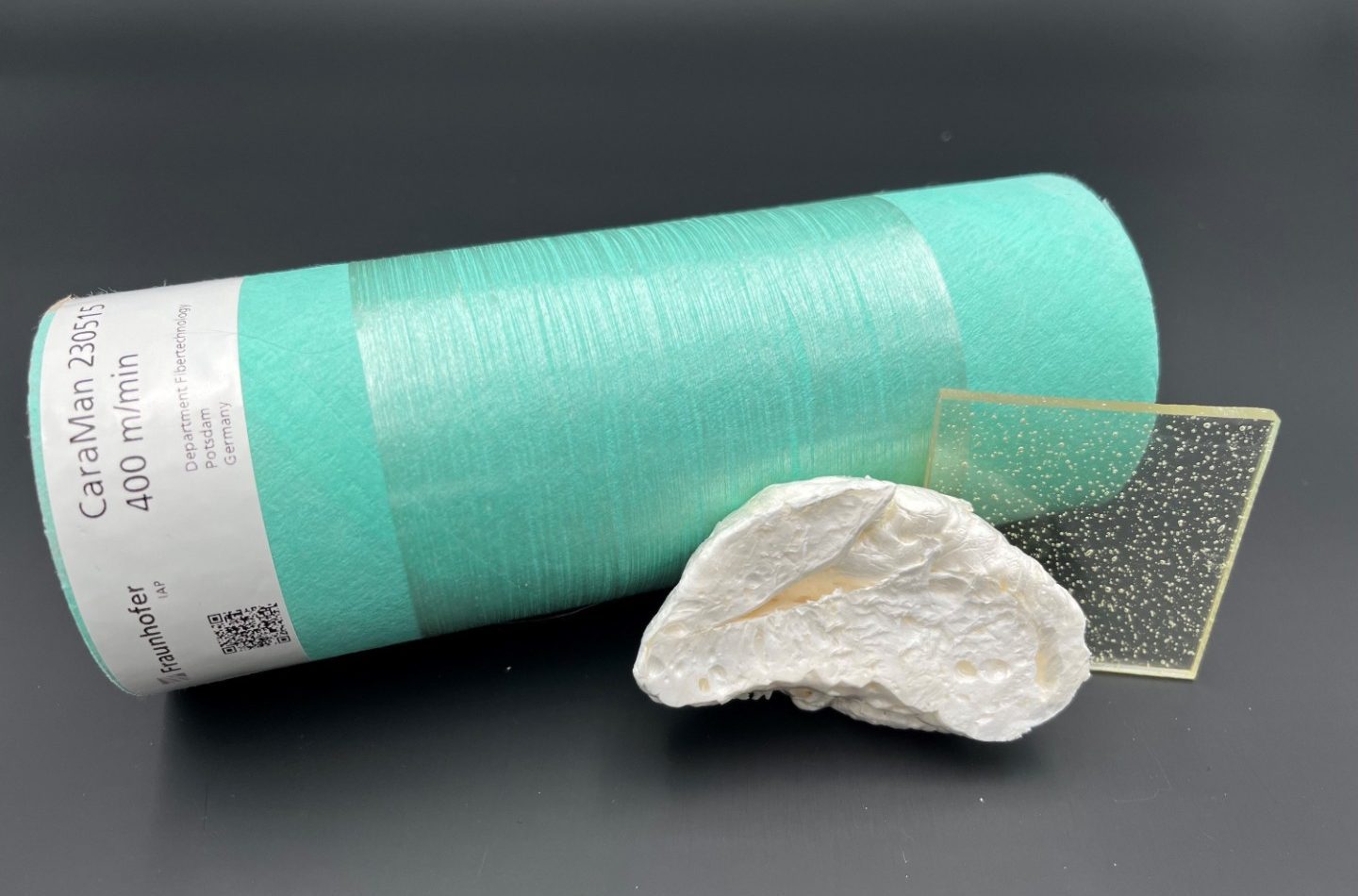
How can new biobased and biohybrid materials with improved functionalities be developed more quickly? This is the question being addressed by six Fraunhofer Institutes working together in the flagship project SUBI²MA. A novel biobased polyamide developed by Fraunhofer researchers serves as a model. Its special properties make it a promising alternative to fossil-based plastics. Demonstrators made from the so-called Caramides developed in the flagship project were presented by the researchers at the Fraunhofer joint stand at the K trade fair in Düsseldorf from October 8 to 15, 2025.
The plastics industry is undergoing transformation: petroleum-based materials are increasingly to be replaced by sustainable alternatives. However, sustainability alone is not enough – biobased plastics must deliver more. Within the flagship project SUBI²MA, Fraunhofer Institutes are working on an approach to develop new materials more rapidly that are not only environmentally friendly but also functionally superior. Their focus is on three main objectives: further development of new biobased materials, new biohybrid materials, and digital fast-track development.
Biological building blocks with functional advantages
At the center of the biobased materials area is Caramid, a new fully biobased high-performance polyamide based on terpenes. Terpenes are natural organic compounds found in many parts of plants such as leaves, flowers, and roots and are the main components of resins and essential oils. The starting material 3-carene used in SUBI2MA, for example, is produced in large quantities as a by-product of pulp manufacturing. Polyamides are thermoplastic high-performance plastics – and Caramid elevates this class to a new level.
Researchers at the Straubing branch of the Fraunhofer Institute for Interfacial Engineering and Biotechnology IGB developed both monomers – so-called caranlactams – and the resulting polymers, Caramides, around ten years ago. “In the SUBI2MA project, the combined expertise of six institutes has now enabled us to think in new ways, scale the caranlactams, and optimize the Caramides and develop them in a more targeted way for specific applications,” says Dr. Paul Stockmann of Fraunhofer IGB.
Due to their special chemical structure, Caramides have exceptional thermal properties, making them interesting for numerous applications: from gears in mechanical engineering to safety glass, lightweight panels, foams, and protective textiles, all the way to surgical suture material. Monofilaments, foams, and plastic glasses have now been produced from the new polyamide. In addition to high-temperature stability, it is highly versatile: “During the project, it became clear that the two caranlactam monomers lead to different Caramides with significantly different properties,” explains the researcher. “Caramid-S, due to its semicrystalline structure, is suitable for fibers, while Caramid-R, due to its so-called amorphous, irregular structure, is suitable for foams.”
Another characteristic is so-called chirality, a spatial property of molecules in which two structural variants exist that are mirror images but not superimposable. This can influence the physical, chemical, or biological functions of a material. In the case of Caramid, material properties can thus be adjusted more precisely, for example for special applications in medical technology or sensor technology. “By integrating biobased building blocks into high-performance polymers, we create a functional advantage. Caramides are therefore not only biobased but even show better performance than fossil-based materials,” Stockmann concludes.
Biohybrid materials
The second objective involves the development of new biohybrid materials. The integration of functional biomolecules gives well-known materials new functions. Fields of application are diverse, ranging from biobased flame retardants for materials to additives or enzymes that accelerate the degradation of petroleum-based PET. Fiber-reinforced materials incorporating biomaterials and diagnostic tools such as novel biosensors represent additional application areas.
“One important function made possible by integrating specific proteins is the hydrophobization of materials – the targeted modification of a material surface so that it repels water,” explains Ruben Rosencrantz, researcher at the Fraunhofer Institute for Applied Polymer Research IAP. Such water-repellent materials are used, for example, in occupational safety and outdoor textiles or medical applications and could in the long term replace environmentally harmful substances such as PFAS.
Digitalization as a turbo for materials development
Based on their own experience, the researchers know that material development and substitution still take a long time, and it is often completely unclear which specific applications a material will best suit. They aim to change this with their third objective, fast-track development. To achieve this, materials development is being digitalized: “We are creating a comprehensive laboratory data base in a simulation-supported and systematically digitalized way,” says Frank Huberth from the Fraunhofer Institute for Mechanics of Materials IWM. “Within this digital value chain, by linking with data-based methods and simulation, property profiles and sustainability can be estimated earlier, thereby significantly accelerating development times for materials and products.” Konrad Steiner from the Fraunhofer Institute for Industrial Mathematics ITWM adds: “Using digital demonstrators, for example for protective textiles and tires, we can save development steps and evaluate the influences and performance of new Caramid fibers at an early stage, without having to produce and test a textile or a complete tire in a time-consuming process.”
Outlook: From laboratory to application
A key driver in the project’s concept was the strong interdisciplinary collaboration between the six Fraunhofer Institutes involved: IGB, IAP, IWM, ITWM, as well as LBF (Institute for Structural Durability and System Reliability), ICT (Institute for Chemical Technology), and an external subcontractor. This made it possible to jointly overcome a major hurdle – scaling the synthesis processes – and both monomers can now be produced on a kilogram scale. Additional funding within the flagship project now enables further industrial-grade demonstrators to be tested, in some cases directly in cooperation with industry. The monomers are to be provided shortly to an associated industrial partner, who will process the base material on its own facilities for a specific application. “This is a crucial step toward advancing the market-ready development of Caramides,” Stockmann concludes. “The project shows how modern materials development can work: biobased from side streams, digital, and interdisciplinary.”